Every marketer talks about conversion rates. Fewer actually understand what the number means once they calculate it.
The conversion rate formula itself is simple — you can learn it in ten seconds. But knowing how to read your conversion rate, spot when it’s misleading you, and use it to make better marketing decisions? That’s where most guides fall short. They show you the math, then leave you to figure out the rest.
This article goes further. You’ll get the formula, real-world calculation examples across e-commerce, lead generation, and SaaS, the latest industry benchmarks, and the critical context that separates marketers who track conversion rates from marketers who actually improve them.
Table of Contents
What Is Conversion Rate (And Why the Definition Matters More Than You Think)?

Conversion rate is the percentage of people who take a desired action out of the total number of people who had the opportunity to take it. That’s the textbook answer, and it’s accurate — but the word “desired action” is doing a lot of heavy lifting.
For an e-commerce store, a conversion might mean a completed purchase. For a B2B company, it might mean a demo request. For an email campaign, it could be a newsletter sign-up. A SaaS product might track free trial activations as conversions, while a content marketing team might count PDF downloads.
This is important because two marketers can both report a “5% conversion rate” and be measuring completely different things. One is measuring purchases against website visitors. The other is measuring form submissions against landing page views. Both numbers are valid, but comparing them without understanding the underlying definitions is like comparing kilometres to miles and wondering why the numbers don’t match.
Before you calculate anything, define exactly what counts as a conversion for your business goal. Get specific. “Leads” is vague. “Completed contact form submissions from the pricing page” is actionable.
The Conversion Rate Formula (With a Plain-English Breakdown)

Here’s the standard conversion rate formula:
Conversion Rate (%) = (Number of Conversions ÷ Total Number of Visitors) × 100
That’s it. Divide the number of people who took the action by the total number of people who could have taken it, then multiply by 100 to express it as a percentage.
1. What Each Variable Actually Represents
Conversions are completed desired actions — not clicks, not page views, not “engagements.” If your goal is purchases, only count completed transactions. If your goal is lead form submissions, only count submitted forms (not people who opened the form and bounced). Partial actions are not conversions.
Total visitors (or total audience) is the pool of people who had a realistic opportunity to convert. This is usually unique visitors to a specific page, total ad impressions, email recipients, or app users during a defined period. The key is consistency: if you’re measuring conversion rate for a landing page, use the number of visitors to that page — not your entire website traffic.
2. A Quick Calculation Example
Say your e-commerce store received 8,000 visitors last month and 200 of them completed a purchase.
Conversion Rate = (200 ÷ 8,000) × 100 = 2.5%
That means for every 100 visitors, roughly 2 to 3 made a purchase. Simple enough. But as you’ll see in the next sections, the interesting question isn’t “what’s the number?” — it’s “what does the number actually tell me?”
Conversion Rate Examples Across Different Business Models

The conversion rate formula works the same way regardless of your business type, but what qualifies as a “conversion” — and what counts as a good result — varies dramatically.
1. E-Commerce Example
An online skincare brand drives 12,000 sessions to their product pages in a month. Of those, 420 result in a completed checkout.
Conversion Rate = (420 ÷ 12,000) × 100 = 3.5%
For e-commerce, the global average purchase conversion rate sits around 1.9–2.1% according to the most recent full-year benchmark data, so 3.5% puts this brand comfortably above average. Personal care products tend to convert higher than most categories — around 6.8% at the top end — so there may still be room to improve.
Also Read: What’s a Good Ecommerce Conversion Rate? Data + Tips
2. Lead Generation Example
A B2B consulting firm runs a LinkedIn ad campaign driving traffic to a whitepaper download page. The page receives 3,000 visitors over two weeks, and 87 people fill out the form and download the PDF.
Conversion Rate = (87 ÷ 3,000) × 100 = 2.9%
According to Ruler Analytics‘ benchmark study across 14 industries and over 100 million data points, the average lead generation conversion rate (visitor to qualified lead) is 2.9%. So this firm is performing at average. The next step would be to look at whether those 87 leads are actually qualified — a topic we’ll cover later.
Also Read: Effective B2B Lead Generation Tips to Boost Your Business
3. SaaS / App Example
A project management SaaS tool sends email traffic to a free trial landing page. Out of 5,000 email recipients who click through, 845 sign up for the trial.
Conversion Rate = (845 ÷ 5,000) × 100 = 16.9%
That looks extraordinary compared to the other examples, but context matters. Email traffic converts at significantly higher rates than cold traffic — Unbounce’s benchmark data shows email traffic to SaaS landing pages converting at a 16.9% median, which is more than four times the rate of the next-best channel. So this result is actually typical for the channel, not exceptional.
The lesson: the same conversion rate formula can produce wildly different numbers depending on the business model, traffic source, and conversion definition. Always compare your rates against the right benchmark — not just a generic “good conversion rate” you read somewhere.
What Does a Conversion Rate Actually Tell You?

Your conversion rate measures efficiency, not volume. That distinction matters more than most marketers realise.
A 5% conversion rate sounds impressive until you learn it came from 200 visitors. That’s only 10 conversions. Meanwhile, a 1.2% conversion rate from 50,000 visitors produces 600 conversions. Which business would you rather have?
- High conversion rate ≠ high revenue. Conversion rate tells you how well you turn visitors into actions, but it says nothing about how many visitors you have, what those conversions are worth, or whether the converted customers stick around. A business with a modest conversion rate but massive traffic and high average order value can vastly outperform a business with an impressive conversion rate but tiny audience.
- Low conversion rate ≠ bad performance. If you’re running broad awareness campaigns or targeting cold audiences, your conversion rate will naturally be lower. That doesn’t mean the campaign is failing — it might be filling the top of your funnel with people who convert later through retargeting or email nurture sequences.
Conversion rate is one piece of the puzzle. It becomes powerful when you combine it with metrics like traffic volume, customer acquisition cost, average order value, and lifetime value. On its own, it can be as misleading as it is helpful — which brings us to the section most other guides skip entirely.
When Your Conversion Rate Is Lying to You

This is where things get interesting, and where you’ll find the real strategic edge. Your conversion rate formula can produce a perfectly accurate number that leads you to a completely wrong conclusion. Here’s how.
1. High Traffic, Low Conversion Rate — Still Profitable
Imagine an e-commerce store with 500,000 monthly visitors and a 0.5% conversion rate. Most advice would say “fix that conversion rate.” But 0.5% of 500,000 is 2,500 orders. If the average order value is $120, that’s $300,000 in monthly revenue. The business is thriving.
Wall Street Prep illustrates this well with a comparison of two companies that both generate $25,000 in monthly revenue — one with a 2% conversion rate from 5,000 visitors and another with a 0.02% rate from 500,000 visitors. The conversion rates look drastically different, but the outcome is identical.
2. Low Traffic, High Conversion Rate — No Scale
The flip side is equally deceptive. A 15% conversion rate on a landing page sounds fantastic. But if that page only gets 100 visitors a month, you’re looking at 15 conversions. For most businesses, that’s not enough to sustain growth. Chasing a higher conversion rate won’t help here — you need more traffic first.
3. Poor Tracking = Wrong Numbers
If your analytics aren’t set up correctly, your conversion rate calculation is built on bad data. Common tracking mistakes include counting bot traffic as visitors (which artificially lowers your rate), double-counting conversions from repeat sessions, not filtering out internal team visits, and tracking the wrong conversion event entirely.
Before optimising your conversion rate, audit your tracking setup. A “low” conversion rate might just be a measurement problem.
4. Optimising for Conversion Rate Can Hurt Growth
Here’s the counterintuitive trap: if you focus too narrowly on improving conversion rate, you might make decisions that limit your business. Removing friction from a form by cutting fields might increase conversions — but the leads you capture may be less qualified. Narrowing your ad targeting to only high-intent keywords will boost conversion rate — but shrink your total addressable audience.
The smartest marketers optimise for revenue or profit, not conversion rate alone. Conversion rate is a diagnostic tool, not a goal.
What Does a 20% Conversion Rate Mean?
If someone tells you they have a 20% conversion rate, your first question should be: “20% of what, converting to what?”
A 20% conversion rate means that for every 100 people in the measured audience, 20 of them completed the desired action. In absolute terms, that’s one in five.
Whether that’s impressive depends entirely on context. A 20% conversion rate on an email click-through to a product page is strong but not unusual for a warm, segmented list. A 20% purchase conversion rate on a cold-traffic landing page would be extraordinary — suspiciously so. A 20% free-trial-to-paid conversion rate for a SaaS product is actually within the expected range, as recent benchmark reports show most SaaS products converting free trial users to paid at roughly 20–25%.
The number only becomes meaningful when you anchor it to a specific funnel stage, traffic source, and industry baseline.
What Is a Good Conversion Rate? (Latest Industry Benchmarks)

There is no universal “good” conversion rate. Anyone who tells you “aim for 2–3%” without asking about your business model is oversimplifying. That said, benchmarks are useful as a starting point — as long as you use them as directional signals, not targets.
Below are the latest available benchmarks across major categories, drawn from the most recent full-year benchmark reports published in late 2025 and early 2026. Since complete 2026 data won’t be available until the year wraps up, these represent the freshest reliable numbers to measure yourself against right now.
1. E-Commerce Conversion Rate Benchmarks
| Segment | Typical Conversion Rate |
| Global e-commerce average | 1.9–2.1% |
| Shopify stores (all) | 2.5–3% |
| Paid traffic (median) | 2.01% |
| Paid traffic (top 20%) | 3.2%+ |
| Paid traffic (top 10%) | 4.7%+ |
| Food & Beverage | 2.7–4.9% |
| Personal Care Products | 6.8% |
| General Retail | 1.9% |
| Consumer Electronics | 1.58% |
| Home Décor | 1.4% |
The pattern is intuitive: lower-priced, frequently purchased products convert higher than expensive, research-heavy ones. If you sell $25 skincare products, comparing yourself against a $2,000 furniture store’s ecommerce conversion rate would be meaningless.
2. SaaS Conversion Rate Benchmarks
| Metric | Benchmark |
| SaaS landing page (median) | 3.8% |
| Email traffic to SaaS pages | 16.9% |
| Paid search traffic to SaaS pages | 4.1% |
| Paid social traffic to SaaS pages | 2.9% |
| Top B2B SaaS website (visitor → lead/trial) | ~11.7% |
| Free trial → paid (typical range) | 20–25% |
Channel matters enormously for SaaS. The 3.8% median is about 42% lower than the 6.6% all-industry landing page median, which reflects how much harder it is to convert visitors on complex B2B products.
3. Lead Generation Conversion Rate Benchmarks
| Channel / Metric | Conversion Rate |
| All industries average (visitor → qualified lead) | 2.9% |
| Direct traffic | 3.3% |
| Paid search | 3.2% |
| Organic search | 2.7% |
| 2.6% | |
| Social media | 1.5% |
4. Landing Page Conversion Rate Benchmarks
| Performance Level | Conversion Rate |
| All-industry median | 6.6% |
| Events & Entertainment | 12.3% |
| Financial Services | 8.4% |
| SaaS | 3.8% |
| “Good” performance | 10%+ |
| Top-decile / excellent | 15%+ |
5. How to Use These Benchmarks
Benchmarks tell you where you stand relative to the market — nothing more. If your e-commerce store converts at 1.2% in a category that averages 2%, you likely have optimisation opportunities. If your SaaS landing page converts at 5% against a 3.8% median, you’re performing well.
But don’t treat benchmarks as ceilings or floors. Your specific traffic quality, offer strength, pricing, and brand recognition all create unique circumstances that no benchmark can fully capture. Use them to ask better questions, not to set arbitrary goals.
CTR vs CVR: What’s the Difference (And Why You Need Both)

These two acronyms get confused often, so let’s clarify.
1. What Is CTR?
Click-through rate (CTR) measures the percentage of people who click on a link, ad, or call to action after seeing it.
The formula is: CTR (%) = (Clicks ÷ Impressions) × 100
CTR tells you how compelling your ad creative, email subject line, or search snippet is. It measures interest and relevance at the top of the funnel.
2. What Is CVR?
Conversion rate (CVR) measures the percentage of people who complete a desired action after clicking through. It picks up where CTR leaves off, measuring whether your landing page, product page, or form actually persuades people to act.
3. Why You Need Both
A high CTR with a low CVR means your ads are getting attention but your landing page isn’t delivering on the promise. A low CTR with a high CVR means your page converts well, but not enough people are seeing it or clicking through.
Diagnosing performance problems requires looking at both metrics together. If your Facebook advertising cost keeps rising but results are dropping, CTR can tell you whether the ad creative is fatiguing, while CVR reveals whether the post-click experience needs work. The same logic applies to Google Ads, email campaigns, and organic search — the click gets them there, the conversion rate shows whether “there” is working.
How Marketers Actually Use Conversion Rate (Beyond Just Tracking It)

The conversion rate formula is a diagnostic tool, and its real value comes from how you apply it across your marketing operations.
1. Evaluating Campaign Performance
When you run multiple campaigns across channels — Google Ads, social media, email, SEO — conversion rate helps you identify which channels deliver the most efficient results. A campaign driving 10,000 clicks with a 1% conversion rate produces 100 conversions. Another campaign with 3,000 clicks but a 4% rate produces 120 conversions from far less traffic. Knowing this, you can reallocate budget toward the higher-converting channel, or investigate why the first channel’s post-click experience underperforms.
This kind of analysis ties directly into understanding key KPIs for marketing that actually drive growth, rather than vanity metrics that look good in reports but don’t move the business.
2. Identifying Funnel Drop-Offs
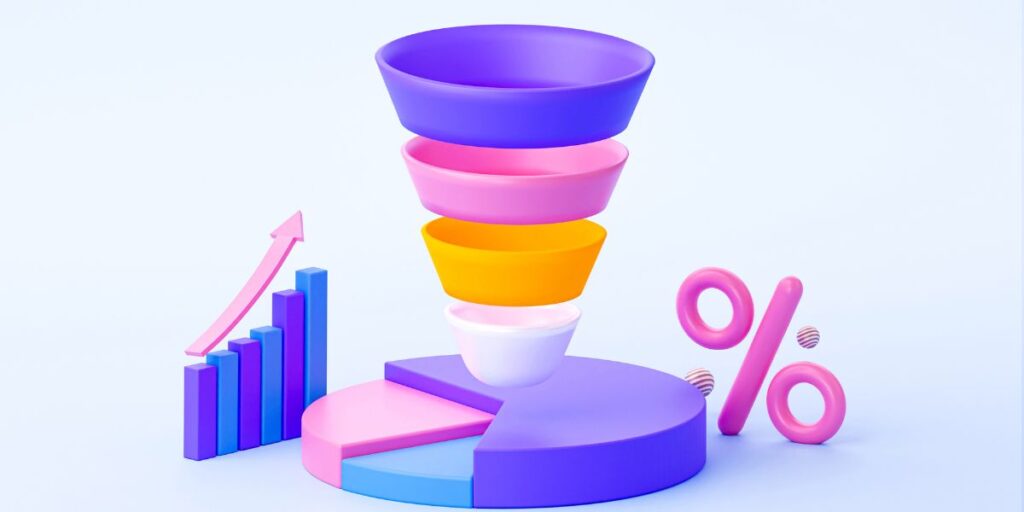
Conversion rate becomes most powerful when you measure it at each stage of your funnel, not just the final outcome. If 1,000 people visit your product page, 300 add to cart, and 45 complete checkout, you know your page-to-cart rate is 30% (decent) but your cart-to-purchase rate is only 15% (likely a checkout friction issue).
This stage-by-stage analysis tells you exactly where to focus. Instead of broadly trying to “improve conversions,” you can pinpoint that your checkout flow needs work — perhaps simplifying the payment process, offering more payment options, or addressing shipping cost surprises.
3. Improving ROI Across Channels
Understanding how to properly allocate budget for digital marketing depends heavily on conversion data. If your Instagram ads costs deliver a 3.2% conversion rate while your Google Search campaigns convert at 5.1%, you can make informed decisions about where your next dollar goes.
But remember the earlier lesson: conversion rate alone isn’t enough. A channel with a lower conversion rate but higher average order value or longer customer lifetime might actually deliver better ROI. Smart marketers look at conversion rate alongside cost per acquisition and revenue per conversion to get the full picture.
How to Improve Your Conversion Rate (Practical CRO Basics)

Conversion rate optimisation (CRO) is a discipline of its own, but these fundamentals apply across nearly every business.
1. Improve Your Traffic Quality
The fastest way to increase conversion rate isn’t to change your website — it’s to send better traffic to it. If you’re running broad-match keywords in Google Ads or targeting loosely defined audiences on social media, you’re bringing in visitors who were never likely to convert.
Refining your audience targeting, focusing on high-intent keywords, and building segmented campaigns for different buyer stages will often improve your conversion rate more than any landing page redesign. This is where finding your target audience with precision becomes a competitive advantage.
2. Optimise Your Landing Pages
Your landing page is where the conversion happens (or doesn’t). A few principles that consistently improve performance include making your value proposition visible within the first screen, matching your page message to whatever brought the visitor there (ad copy, email subject line, search query), reducing distractions by removing unnecessary navigation and competing CTAs, and using social proof — testimonials, client logos, case studies — to build trust.
For context, industry benchmarks consider a 10% landing page conversion rate “good” and 15%+ as optimisation excellence. If you’re below the 6.6% all-industry median, these fundamentals are usually the first place to look.
Also Read: Why is UGC So Important for Brand? 10 Key Benefits Revealed
3. Strengthen Your Offer and Messaging
Sometimes the issue isn’t the page layout or the traffic — it’s what you’re offering. A weak or unclear offer won’t convert regardless of how well-designed the page is. Ask yourself: is the value proposition specific and compelling? Does the visitor immediately understand what they get and why it matters? Is the perceived risk low enough for them to act?
Improving your offer — whether through better pricing, stronger guarantees, clearer benefit statements, or more relevant lead magnets — can have an outsized impact on conversion rate.
4. A/B Testing and Continuous Optimisation
Once your fundamentals are in place, A/B testing lets you systematically improve over time. Test one variable at a time — headline, CTA button text, form length, hero image — and let statistical significance guide your decisions rather than gut feeling.
The companies that consistently outperform in conversion rate are the ones that treat it as an ongoing discipline, not a one-time project. They test, learn, implement, and repeat.
Common Conversion Rate Mistakes That Cost You Money

Even experienced marketers fall into these traps. Avoiding them will save you time, budget, and misleading data.
- Tracking the wrong conversion. If your business goal is qualified leads but you’re measuring form views as “conversions,” your conversion rate will look inflated but won’t reflect actual business outcomes. Match your conversion event to the action that genuinely matters to revenue.
- Ignoring user intent. Traffic from a branded search query (someone searching your company name) will always convert at a higher rate than traffic from an informational query. Lumping all traffic together and looking at one blended conversion rate obscures these differences and leads to poor optimisation decisions.
- Over-optimising small traffic samples. If your landing page got 150 visitors last month and 8 converted, that’s a 5.3% conversion rate. But with such a small sample, that number could easily be 2% or 9% next month. Don’t make major strategic decisions based on conversion rates from thin traffic. Wait until you have statistically meaningful volume before drawing conclusions.
- Not testing consistently. Running one A/B test, implementing the winner, and then never testing again is surprisingly common. Markets change, audiences evolve, and what worked six months ago may not work today. Build testing into your regular workflow.
- Comparing incomparable numbers. As we covered earlier, a 3% conversion rate on cold paid social traffic is very different from a 3% rate on warm email traffic. Always compare conversion rates within the same traffic source, funnel stage, and time period.
Why Conversion Rate Matters for Your Digital Marketing Strategy

We’ve covered the formula, the benchmarks, the pitfalls, and the practical applications. So why does this metric deserve so much attention?
- It measures whether your marketing actually persuades people. Traffic is attention. Conversion is action. You can drive a million visitors to your site, but if nobody buys, signs up, or contacts you, those visits have no commercial value. Conversion rate bridges the gap between reaching people and getting them to respond.
- It reveals traffic quality. When conversion rates differ significantly across channels, that’s a signal about audience quality, not just page performance. Organic search visitors who typed a specific query tend to convert higher than casual social media browsers. Understanding this helps you invest in the channels that deliver visitors with real purchase intent.
- It helps you optimise ROI without spending more. Improving your conversion rate from 2% to 3% on the same traffic means 50% more conversions without a single extra dollar in advertising. For businesses managing tight budgets — which is most SMEs — this kind of efficiency gain can be transformative.
- It grounds your strategy in evidence. Instead of guessing which campaigns work, conversion rate gives you a clear, quantifiable measure to compare and optimise. When combined with metrics like customer acquisition cost and lifetime value, it forms the foundation of a data-driven marketing approach.
Key Takeaways
The conversion rate formula — (Conversions ÷ Total Visitors) × 100 — is one of the simplest and most important calculations in marketing. The real skill is in everything that comes after the calculation.
Context determines meaning. A 2% rate can be excellent or terrible depending on your industry, traffic source, funnel stage, and conversion definition. Always benchmark against comparable scenarios, not generic averages.
Conversion rate is a diagnostic tool, not a north star. Optimising for conversion rate alone can lead you to shrink your audience, lower lead quality, or ignore profitable channels with naturally lower conversion rates. Use it alongside traffic volume, acquisition costs, and revenue metrics for a complete picture.
Benchmarks give you a starting point. Based on the latest available data, e-commerce averages around 2%, landing pages around 6.6%, lead generation around 2.9%, and SaaS landing pages around 3.8%. But your specific circumstances — product, pricing, audience, brand strength — will always matter more than an industry average.
Improvement is an ongoing discipline. Knowing the conversion rate formula is step one. The companies that consistently achieve strong conversion rates are the ones that continuously test, measure, and refine. They audit their tracking, segment their data, run systematic A/B tests, and treat CRO as a habit rather than a one-time project.
For businesses that want to go beyond surface-level metrics and build marketing strategies that actually drive results, working with a partner who understands the nuances makes a difference. Katartizo, a Singapore-based digital marketing agency, specialises in helping SMEs turn data — including conversion rate analysis — into actionable strategies that deliver measurable growth across SEO, paid advertising, and content marketing.