Most articles about marketing ideas for realtors dump 20, 30, or even 50 tactics on you. Try them all, the thinking goes, and something will stick. The problem is that something rarely does, and you end up tired, scattered, and still chasing the same handful of leads.
The honest reality of real estate marketing is that a few channels drive the vast majority of your business, and the rest is busywork. According to the National Association of Realtors 2025 Profile of Home Buyers and Sellers, 66% of sellers found their agent through a referral or past relationship, and referral leads convert at 14 to 20 percent, far higher than the 0.4 to 1.2 percent you see on portal leads. That single data point should reshape how you think about every marketing dollar.
This guide gives you something different: prioritized marketing ideas for realtors organized by impact, a framework for choosing what to focus on, and Singapore-aware context for property agents who need to navigate CEA rules and local platforms. Whether you’re a new salesperson trying to land your first ten clients or an established agent looking to systematize your pipeline, the goal is to help you stop chasing shiny objects and start building a marketing system that compounds.
Table of Contents
Why Most Marketing Ideas for Realtors Don’t Convert

The standard advice goes something like this: post on Instagram, run Facebook ads, do open houses, send postcards, build a website, blog about your neighborhood, get on TikTok, send email newsletters, and so on. None of it is wrong. All of it is overwhelming.
Here’s the data that matters. Most agents spend 7 to 10 percent of their gross commission income on marketing, with growth-phase agents going to 15 to 20 percent, and the median agent spends about US$8,010 per year. That’s a meaningful budget. But if it’s split across ten channels with no system behind any of them, the return is almost always disappointing.
The pattern that separates top producers from everyone else isn’t more marketing. It’s deeper marketing in fewer places. A 2025 NAR Technology Survey found that 75% of top-performing agents now use AI tools regularly versus 49% of all agents. The same divide exists across every channel: a focused agent who posts strategic video three times a week beats an unfocused agent posting random content seven times a week.
For Singapore agents, the channel reality is even more concentrated. PropertyGuru commands 84% of Singapore’s real estate portal traffic versus 16% for 99.co, and WhatsApp dominates client communication in ways most US-centric advice completely misses. With 36,058 registered property agents in Singapore as of January 2025, standing out in this market isn’t about doing more. It’s about doing the right things consistently.
The Foundation Every Realtor Needs First

Before any of the creative marketing ideas for realtors later in this guide will work, four foundational pieces have to be in place. Skipping these is the most common reason marketing budgets get wasted.
1. Personal brand vs. agency brand
You’re not just selling properties. You’re selling yourself. Buyers and sellers choose people, not logos. Develop a clear personal positioning that answers three questions: who do you serve, what problem do you solve, and why should they trust you specifically? This becomes the thread that runs through every marketing channel. For agents in Singapore working under a Key Executive Officer (KEO), your personal brand still matters more than the agency’s. Clients don’t refer “ERA” or “PropNex.” They refer to Jane Tan.
2. Professional photography and video
Listings with professional photos sell faster and at higher prices, but the bar has moved. In 2026, buyers expect video walkthroughs as standard, and the agents who provide them stand out. AI-powered virtual staging now costs US$20 to 100 per listing versus US$2,000 to 5,000 for physical staging, a 95% cost reduction. Singapore agents should note that CEA practice guidelines require real photographs only; fake or heavily edited images are not allowed, and that includes any AI-generated imagery that misrepresents the actual property.
3. A working lead-capture site
You don’t need a beautiful agency-style website. You need a page that captures leads. A single landing page with your value proposition, a few listing highlights, social proof, and a clear contact form will outperform a sprawling site that doesn’t ask visitors for anything. Mobile-first design is non-negotiable. Form length matters too: 2025 research shows shorter forms with fewer fields consistently convert higher than long ones.
4. Google Business Profile and local listings
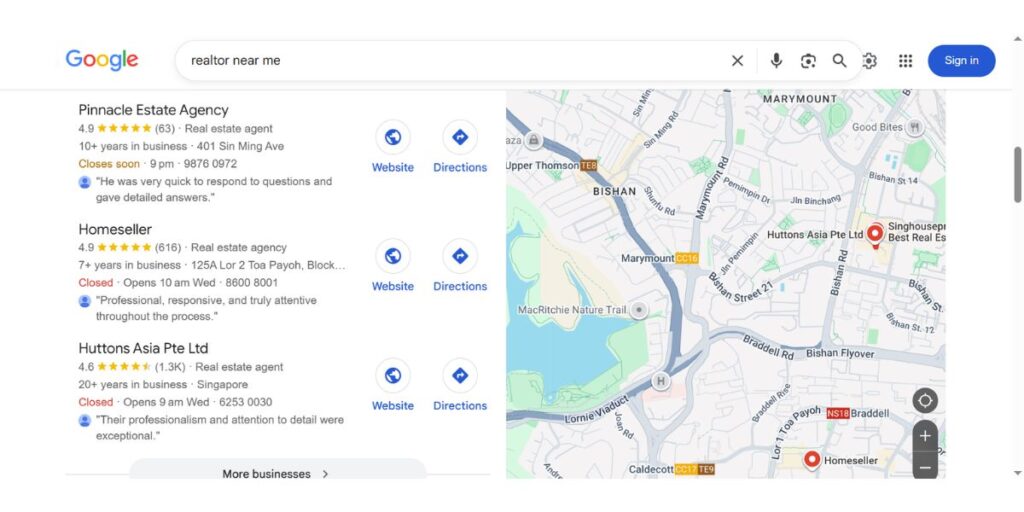
Real estate is hyperlocal, which makes Google Business Profile one of the highest-ROI free tools available. Complete every field, post weekly updates, request reviews after every closed transaction, and respond to every review, including negative ones. For Singapore agents, this matters less for individual searches (where PropertyGuru dominates) but matters enormously when potential clients search your name directly.
High-Impact Marketing Ideas for Realtors (Where Most Leads Come From)
These are the channels with the strongest evidence behind them. If you can only invest in five marketing ideas for realtors, start here.
1. Local SEO and neighborhood content
Organic search converts real estate leads at 3.2%, more than double the rate of paid search at 1.5%. The way to win here isn’t generic content like “how to buy a house.” It’s neighborhood-level expertise. Write detailed guides to specific districts, school zones, and condo developments. In Singapore, that means writing about specific HDB estates (Bishan, Tampines, Punggol) or condo clusters (the District 9/10/11 luxury corridor, Bukit Timah’s GCB belt, Sengkang’s family-friendly newer developments).
This is also where having a solid content marketing strategy pays off. Neighborhood content compounds over time, building a library that ranks for hundreds of long-tail searches without ongoing ad spend.
2. Hyper-local Facebook and Instagram ads
Paid social converts at roughly 0.9 to 2.1 percent depending on the study, but for realtors the value is in audience targeting. You can serve ads to people who live within 2km of a listing, or to specific income brackets and life-stage segments. The mistake most agents make is treating Facebook ads as a one-off lead-grab. They work best as a sustained nurture system. Understanding facebook advertising cost dynamics and how to target audience on facebook properly is what separates agents who burn money on ads from those who scale them.
For Instagram specifically, instagram ads cost in 2026 remains competitive for visual-heavy verticals like real estate, and Reels continue to deliver strong organic reach when ad campaigns are paired with consistent content.
3. Referral systems and past-client retention
This is the single highest-leverage channel and the one most agents neglect. Referrals convert at 14 to 20 percent, meaning one in five referred leads becomes a closed transaction. The problem isn’t that agents don’t know referrals matter. It’s that they don’t systematize them.
A working referral system has three components: a structured ask after every transaction, an ongoing nurture sequence for past clients (quarterly check-ins, market updates, home anniversary messages), and a measurable reward, whether that’s a referral fee, a thank-you gift, or simply being top-of-mind through consistent value delivery. Agents who close 40+ transactions per year almost always have a referral engine running in the background.
4. Email nurture for the long game
Email marketing converts at 1.4% for real estate specifically and 2.6% on cross-industry benchmarks, but more importantly, it works on a different timeline. Most buyers and sellers don’t transact when they first hear about you. They transact 6 to 18 months later. Email keeps you in their pocket through that entire window.
Build a monthly newsletter with three sections: market data and updates, a featured listing or neighborhood spotlight, and one personal note (a client story, a renovation tip, something human). Singapore agents need to be careful about PDPA compliance: you need consent before adding people to email lists, and you need a clear opt-out option in every send. For practical guidance, see our piece on the advantages of email marketing and how to structure campaigns that build long-term trust.
5. Strategic video content
Video has gone from “nice to have” to table stakes. According to NAR data, 41% of home buyers find 3D tours and video content very useful in their buying process, and listings with video receive significantly more inquiries than those without. But you don’t need a film crew. Short-form vertical video shot on a phone, including neighborhood walkthroughs, market updates, and behind-the-scenes from showings, outperforms expensive production in most cases.
Start with a content calendar of three videos per week: one neighborhood spotlight, one buyer/seller education, and one personal. Post natively to Instagram Reels, TikTok, and YouTube Shorts, then repurpose the long-form version on YouTube and LinkedIn.
Content Marketing Ideas That Build Authority

If high-impact channels are how you generate leads this month, content marketing is how you generate them every month for the next five years. These marketing ideas for realtors are about building authority that compounds.
1. Neighborhood and district guides
Pick five to ten neighborhoods you genuinely know well and write definitive guides to each. School data, commute analysis, recent transaction prices, character of the area, who it suits and who it doesn’t. These guides become evergreen SEO assets and natural lead magnets. For Singapore agents, this is where bilingual content (English and Mandarin, especially for HDB resale markets) can dramatically widen your reach.
2. Buyer and seller education content
First-time buyers and sellers are anxious and information-hungry. Create checklists, timelines, and explainers that walk them through the entire process. In Singapore, this means content on ABSD, BSD, TDSR, MSR for HDB loans, the difference between OTP and S&P, and the cooling measures that affect timing. The agent who explains these things clearly becomes the agent they trust to handle the transaction.
3. Market updates and data storytelling
Most agents share market data poorly. They post URA flash estimates with no commentary, or vague claims like “the market is hot right now.” Better: take one data point per week and explain what it means for a specific buyer or seller. “HDB resale prices in Toa Payoh rose 2.1% last quarter, here’s what that means if you’re thinking of upgrading to a condo.” Done weekly, this builds your reputation as the market analyst, not just an agent.
4. Bilingual content for Singapore agents
This is one of the most under-utilized angles in Singapore real estate marketing. The HDB resale market in particular has substantial Chinese-language demand, and a property agent who produces content in both English and Mandarin (or Bahasa Melayu, depending on the demographic) significantly expands their addressable audience. Even partial bilingual posts, like English captions with key terms in Mandarin, outperform monolingual content in many SG neighborhoods.
Unique and Creative Marketing Ideas Beyond the Basics

These are the marketing ideas for realtors that competitors don’t talk about. The kind that separates memorable agents from forgettable ones.
1. Experiential open houses
The standard open house is dying. NAR data shows open houses are the first touchpoint for only 3% of buyers. The agents who still win with them have turned them into experiences. Pair an open house with a neighborhood activity: a coffee tasting with the local café, a yoga session in the garden, a kids’ craft table for family viewings. People remember experiences. They forget tours.
2. Hyperlocal community sponsorships
Sponsor a youth football team in the neighborhood where you specialize. Underwrite the local community festival. Buy the back cover of the condo’s monthly newsletter. These look small on a spreadsheet, but in real estate, recognition compounds. The agent whose name appears on the kids’ jerseys becomes the agent the parents call when they’re ready to upgrade.
3. WhatsApp broadcast lists (Singapore-specific)
This is one of the most underrated marketing ideas for realtors in Singapore specifically. While US agents focus on email, Singapore clients live on WhatsApp. A well-curated broadcast list (consent-based, segmented by interest) for new launches, hot resale listings, and market updates can outperform email by 5 to 10 times in open rate. Keep messages short, add value before pitching, and respect frequency. One or two messages a week, not daily.
4. AI-generated content and virtual staging
AI adoption in real estate marketing has crossed from experimentation to standard practice. 97% of brokerages reported agents using AI tools in 2026. The clearest ROI use cases right now are:
AI listing descriptions: 82% of agents now use AI for this, cutting writing time from 40 minutes to 30 seconds per listing.
AI virtual staging: saves US$2,000 or more per listing compared to physical staging.
AI chatbots for first-touch lead response: cut response time from 8 hours to under 2 minutes, with one study showing lead conversion improvement of 40% with AI nurturing versus manual follow-up.
The caveat is significant. AI can hallucinate features the property doesn’t have (“new roof,” “renovated kitchen”) and can generate language that violates Fair Housing rules in the US or CEA practice guidelines in Singapore. Every AI output needs human verification before it goes public. For more on building an AI workflow that doesn’t get you in trouble, see our breakdown of the best ai marketing tools for marketers.
5. Niche positioning
The riskiest move in real estate marketing is trying to be everything to everyone. The most successful agents niche down hard: expats relocating to Singapore, en bloc specialists, luxury landed homes in District 10, first-time HDB buyers under 35, retirees downsizing from condos. A clear niche makes every other marketing decision easier. Your content writes itself, your ads target themselves, and your referral network sharpens.
Marketing Ideas for Realtors on a Tight Budget

Not every agent has S$5,000 a month to spend. The good news is that some of the most effective real estate marketing tactics cost almost nothing.
Google Business Profile is free and high-ROI. A weekly LinkedIn post about your market is free. Joining one community Facebook group and contributing genuinely (without pitching) is free. Asking every past client for a referral is free. Recording a phone-shot video walkthrough of a new listing is free. Showing up to one community event a week with business cards is essentially free.
The trade-off is time. Low-budget marketing is high-effort marketing. Agents who succeed on tight budgets are disciplined about doing two or three things consistently rather than five things sporadically. As your budget grows, the how to allocate budget for digital marketing questions gets more strategic. Most agents do well with roughly 70% on proven channels, 20% on scaling experiments, and 10% on testing new ideas.
Singapore-Specific Marketing Considerations

For property agents working in Singapore, marketing ideas for realtors come with a compliance layer that US-focused content completely ignores. Getting this wrong isn’t just embarrassing. It can cost you your license.
1. CEA advertising rules
The CEA Practice Guidelines on Ethical Advertising require every property advertisement to display the salesperson’s name, CEA registration number (starting with “R” followed by 7 digits), and contact number. You cannot use unsubstantiated superlatives like “King of [location],” “Mr. [location],” or “Specialist” without proof. You cannot publish prices significantly lower than developer prices to bait inquiries. You cannot post listings without the owner’s written consent. SMS marketing has strict rules: opt-out must be provided, and no SMS between 10pm and 9am.
Enforcement is real and getting tougher. In October 2025, a property agent who had already been fined S$14,000 and suspended for misleading advertisements was hit with a further S$28,000 fine and a six-month suspension after re-offending. ERA Realty Network received a Letter of Censure in December 2025 for failing to supervise the agent behind the misleading ads. Disciplinary Committee penalties can reach S$100,000 per case.
2. PropertyGuru, 99.co, and EdgeProp
PropertyGuru receives roughly 1.82M monthly Singapore visits versus 99.co’s 640K, but average visit duration on PropertyGuru is 5:49 versus 2:25 on 99.co, meaning PropertyGuru users are deeper-intent. Both should be part of your portal strategy, but allocate listing investment proportionally. EdgeProp remains a strong secondary channel, particularly for buyers researching investment-grade properties.
3. PDPA and WhatsApp marketing
Singapore’s Personal Data Protection Act requires consent before you can use someone’s contact details for marketing. WhatsApp broadcast lists are powerful but they need to be consent-based, and you should provide a clear opt-out. PDPA fines reach significant amounts, and Do Not Call (DNC) Registry violations carry penalties up to S$1 million for corporations.
4. HDB vs. private property positioning
These are essentially different markets requiring different marketing approaches. HDB buyers are more price-sensitive, often first-timers, and respond well to grant calculators, neighborhood school data, and resale process content. Private property buyers (especially in the District 9/10/11 corridor or the East Coast) respond better to investment analysis, rental yield content, and lifestyle positioning. Trying to market the same way to both audiences is one of the most common mistakes Singapore property agents make.
This is the kind of strategic layer where working with a digital marketing agency in Singapore that actually understands the local market makes a meaningful difference. At Katartizo, we work with SMEs and professional services businesses across Singapore who need integrated SEO, social media, and paid advertising under one strategic roof, built around compliance realities rather than ignoring them.
How to Choose Which Marketing Ideas to Focus On

With 20+ tactics above, the real question isn’t “which ideas are good” but “which ideas are right for me right now.” Use this simple decision framework.
By experience level: if you’re in your first 12 months, focus relentlessly on referral systems, neighborhood content, and one social channel. Don’t try to be on five platforms; you won’t have content for any of them. If you’re 2 to 5 years in, layer paid ads, email nurture, and video on top of your existing referral base. If you’re a top producer, the question shifts to building a marketing system that runs without you, including automation, hiring a part-time content creator, and scaling what works.
By budget tier: under S$500 a month, focus on free channels (Google Business Profile, LinkedIn, organic social, referral systems). At S$500 to 2,000 a month, add basic paid social ads, email tool subscription, and professional photography for every listing. At S$2,000 to 5,000 a month, add SEO content production, retargeting campaigns, and possibly an agency partnership. Above S$5,000 a month, you should have a marketing system, not just marketing activities.
By energy and personality: introvert agents tend to do well with content marketing, email, and SEO, which are quiet channels that compound. Extrovert agents tend to do well with video, community events, and referral networking, which are high-energy channels that depend on personality. Don’t fight your nature; lean into what you can do consistently.
Common Marketing Mistakes Realtors Make

Even with all the right real estate marketing tactics, execution kills more campaigns than strategy. The most common mistakes:
Random posting without strategy. Posting whenever you feel like it, on whatever topic, with no editorial calendar. The algorithm punishes inconsistency, and your audience gets nothing they can rely on.
Chasing every new platform. TikTok, Threads, BeReal, Lemon8: every six months there’s a new platform some guru says you “have to be on.” You don’t. Pick two or three platforms where your target audience actually lives and go deep.
Not tracking what works. Most agents can’t answer the question “where did your last 10 clients come from?” If you don’t know, you can’t double down on what works or cut what doesn’t. Track lead source for every inquiry. Even a simple spreadsheet beats no tracking. For more on measurement, see our piece on key kpis for marketing that actually predict growth.
Generic content that could be any agent. “Just listed!” “Open house this weekend!” “Market update, prices up!” None of this differentiates you. The agents who win create content only they could create, including their voice, their neighborhood, their specific perspective.
Slow lead response.48% of leads are lost due to slow response time. If you take 8 hours to reply to a portal inquiry, that lead is already talking to three other agents. Reply within 5 minutes if you can. Use an AI chatbot or auto-responder for after-hours so leads at least know you’ll get back to them.
Final Take: From Marketing Ideas to a Marketing System
The biggest shift most realtors need to make isn’t adding more marketing ideas for realtors to their list. It’s converting their scattered activities into a system: consistent inputs that produce predictable outputs.
A marketing system has three layers. The foundation is your personal brand, your lead-capture site, your professional content assets, and your CRM. The acquisition layer is two or three channels you run consistently, such as local SEO content, paid social, email nurture, and referral asks. The retention layer is the long-term nurture engine that keeps you in front of past clients and your sphere of influence for years. Every tactic in this guide fits somewhere in those three layers. Tactics outside the system are just noise.
Building this kind of integrated marketing system is exactly what Katartizo does for SMEs and professional services businesses across Singapore. We help agents and small teams move from running disconnected tactics to running a marketing engine: strategy first, then SEO, social, paid ads, and content working together. If you’ve been doing marketing for a while but the results feel random, that’s almost always a system problem, not an effort problem.
The agents who win in 2026 won’t be the ones running the most marketing ideas for realtors. They’ll be the ones running fewer, better, and more consistently, backed by data, supported by AI where it actually helps, and grounded in genuine relationships. Pick three to five ideas from this guide. Run them for ninety days. Measure what worked. Then double down on what did and let go of what didn’t. That’s how marketing for realtors actually compounds.
Frequently Asked Questions
What is the 3-3-3 rule for marketing?
The 3-3-3 rule actually refers to several different frameworks depending on context, all sharing the same name. The most useful version for realtors is the simplified marketing focus version: pick 3 core messages, 3 audience segments, and 3 marketing channels, and go deep on those rather than spreading thin.
There’s also a real estate buyer-guidance version: see 3 homes you love, view each 3 times, wait 3 days before deciding. And a content-timing version: 3 seconds to grab attention, 30 seconds for storytelling, 3 minutes to convert. None of them have a single original author. The rule has emerged organically across marketing communities since around 2024.
What type of marketing is best for real estate?
The honest answer is that it depends on your stage and market. But the data points consistently to a referral-first system supplemented by local SEO, paid social ads, and email nurture as the core mix. Referrals convert at 14 to 20 percent versus 0.4 to 1.2 percent for portal leads, so any agent who isn’t actively building a referral system is leaving most of their potential business on the table. Social media is a brand-building and nurture channel, not primarily a lead-generation channel. 19% of agents report it as a lead source, but it usually accounts for only 1 to 5 percent of their actual business.
What are the 7 P’s of marketing in real estate?
The 7 P’s adapt the traditional marketing mix for service businesses. In a real estate context they are: Product (the property itself and its features), Price (positioning relative to the market), Place (location and distribution channels, including portals, MLS, and your own site), Promotion (how you market the property and yourself), People (you, your team, and your network), Process (the buying or selling journey you guide clients through), and Physical Evidence (photos, virtual tours, signage, brochures, and anything tangible that signals professionalism). Some agents also reference the classic 4 P’s (Product, Price, Place, Promotion), but the 7 P’s framework is more accurate for a service-driven industry like real estate.
What are some unique marketing ideas for realtors?
Beyond the obvious, the most differentiated marketing ideas for realtors tend to be the ones tied to a specific niche or community. Experiential open houses paired with neighborhood activities. WhatsApp broadcast lists for hot listings (especially in Singapore). AI virtual staging for vacant or dated properties. Hyperlocal sponsorships (youth sports teams, community festivals). Bilingual content for multilingual markets. A signature client-onboarding gift that gets photographed and shared. Niche podcasts focused on a single neighborhood or property type. The pattern is consistent: unique marketing comes from going deep on a specific audience, not from creative tactics applied to a generic audience.
How much should realtors spend on marketing?
The industry rule of thumb is 10% of Gross Commission Income, with most agents spending 7 to 10 percent and growth-phase agents going to 15 to 20 percent. The more important question is how you allocate that spend. Burning S$2,000 a month on Facebook ads with no tracking is worse than spending S$500 a month on a focused system. For practical allocation, see our guide on how to allocate budget for digital marketing using the 70/20/10 framework.