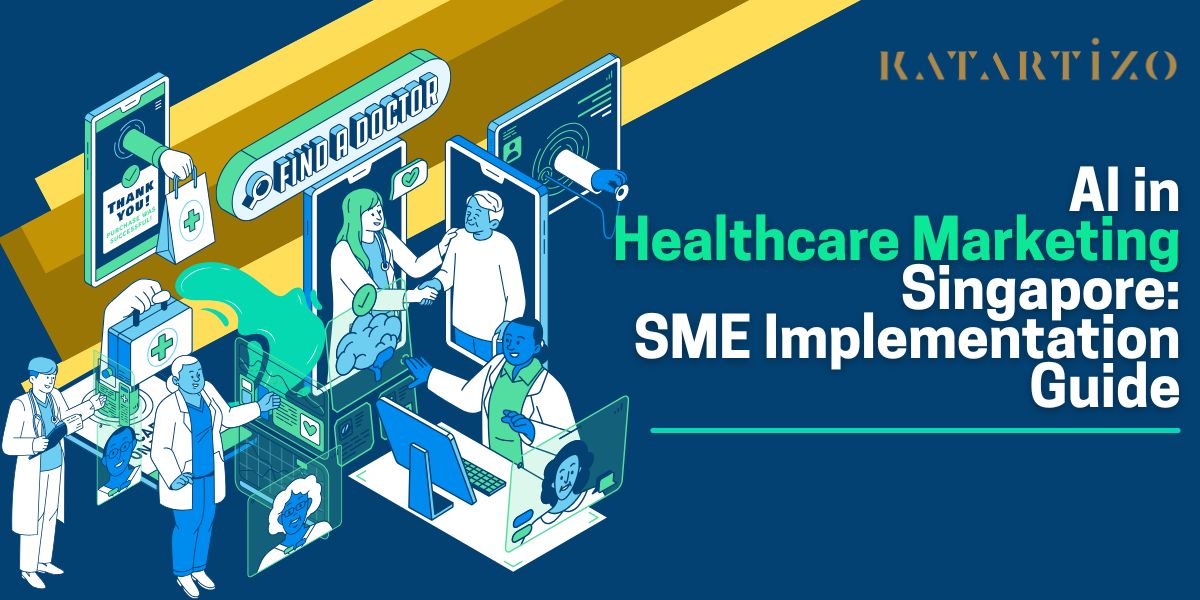
Singapore’s healthcare AI revolution is delivering measurable results. SGH’s PEACH Chatbot alone saves $200,000 annually while reducing doctor documentation time by 6 minutes per patient. SingHealth’s Note Buddy supports 2,100+ clinicians with 16,000+ clinical notes, reducing documentation time by 50%.
Yet many Singapore healthcare providers remain hesitant about AI in healthcare marketing implementation, uncertain about costs, compliance, and practical applications. With Singapore’s AI healthcare market growing from $78.1M (2023) to a projected $881.3M by 2030, a 41.4% CAGR, early adoption creates significant competitive advantages.
This comprehensive guide provides practical AI in healthcare marketing implementation strategies specifically designed for Singapore’s regulated environment, diverse patient base, and growing medical tourism industry projected to reach $4,012M by 2033.
Table of Contents
What Is AI in Healthcare Marketing?

AI in healthcare marketing applies artificial intelligence technologies, machine learning, natural language processing, and predictive analytics to enhance patient engagement, streamline communications, and optimize marketing campaigns while maintaining strict healthcare compliance standards.
Unlike clinical AI systems focused on diagnosis and treatment, marketing AI targets the patient journey: from initial awareness through treatment completion and ongoing care relationships. This distinction is crucial for Singapore healthcare providers operating under the Personal Data Protection Act (PDPA), which requires explicit consent and transparent data handling practices.
Singapore’s unique healthcare landscape serving 500,000+ annual medical tourists while maintaining some of the world’s strictest data privacy standards, makes strategic AI in healthcare marketing implementation essential for competitive success. The integration must balance automation efficiency with the personal trust relationships fundamental to healthcare decisions.
With 28% of Singapore healthcare professionals already using AI for diagnostic accuracy (ranking 3rd globally), marketing applications represent the natural next evolution for providers seeking comprehensive digital transformation.
Real ROI: What Singapore Healthcare Providers Are Achieving

1. Documented Cost Savings and Efficiency Gains
Singapore’s healthcare institutions are demonstrating quantifiable AI in healthcare marketing returns that extend beyond traditional marketing metrics:
Operational Efficiency Improvements:
- Hospital operational costs reduced by 10-20% through AI platforms like Endeavour AI
- Diagnostic costs decreased by approximately 25% through AI imaging integration
- Treatment costs reduced by 30-40% through early AI-powered detection systems
- Documentation time savings of 50% across clinical workflows
Marketing Automation ROI Benchmarks: Healthcare practices implementing marketing automation see 10-20% average ROI, with companies earning $5.44 for every $1 spent, a 544% return. Real case studies include an urgent care clinic achieving 24.40x ROI and a vascular surgeon practice reaching 4.40x ROI on their marketing automation investments.
2. Implementation Cost Realities
Understanding actual implementation costs helps Singapore healthcare providers budget appropriately for AI in healthcare marketing initiatives:
Development Cost Ranges:
- Basic healthcare chatbot: $3,000-$45,000 for small to mid-tier implementations
- Comprehensive AI healthcare app: ~$150,000 for initial version development
- Basic medical image analysis AI: $50,000-$150,000 depending on complexity
- Enterprise marketing automation platform: Custom pricing typically ranging from $10,000-$100,000 annually
These costs must be evaluated against potential savings and revenue increases. Given SGH’s $200,000 annual savings from a single chatbot implementation, ROI timelines for properly designed systems often fall within 6-18 months.
Key Applications of AI in Healthcare Marketing

1. Personalized Patient Engagement at Scale
Modern patients expect healthcare communications tailored to their specific conditions, cultural background, and communication preferences. AI in healthcare marketing enables this personalization across Singapore’s diverse population while maintaining regulatory compliance.
Proven Implementation Examples: The KKH UPAL Pediatric Chatbot, Singapore’s first pediatric medical chatbot launched in 2019, demonstrates successful multilingual patient engagement. The system processes natural language queries in Singlish (Singapore English/Mandarin mix) while providing 24/7 guidance for caregivers.
Practical Applications Include:
- Culturally appropriate preventive health reminders based on ethnic health risk factors
- Chronic disease management campaigns targeting specific demographics
- Treatment adherence support through personalized messaging in preferred languages
- Post-treatment follow-up sequences optimized for cultural communication preferences
2. Advanced Predictive Analytics for Patient Behavior
Healthcare providers can anticipate patient needs and optimize resource allocation using predictive modeling that analyzes historical patterns, engagement data, and demographic factors. This capability proves particularly valuable in Singapore’s high-volume, efficiency-focused healthcare environment.
Predictive Capabilities Delivering Results:
- No-show prediction accuracy improvements enabling better scheduling optimization
- Treatment completion likelihood assessment for targeted intervention programs
- Patient leakage risk identification across specialty services and referral networks
- Population health campaign targeting based on epidemiological and behavioral patterns
Singapore’s comprehensive healthcare data infrastructure, combined with strong privacy protections, creates ideal conditions for advanced predictive analytics while maintaining patient confidentiality through proper anonymization protocols.
3. AI Chatbots & Virtual Assistants: Platform Comparisons
Healthcare chatbot selection requires balancing functionality, compliance, and cost considerations. Here’s a detailed comparison of platforms suitable for Singapore healthcare providers:
Enterprise-Level Platforms:
- Ada Health: AI symptom assessment platform with 4.6/5 user rating, custom enterprise pricing, GDPR/HIPAA compliant
- Sensely: Virtual nurse avatar with remote patient monitoring, 4.3/5 rating, custom pricing model
- Kore.ai: HIPAA-compliant with no-code builder, enterprise custom pricing
- Healthily: AI symptom checker with extensive clinical library, security compliant
Singapore-Specific Solutions:
- PEACH (SGH): Perioperative assessment chatbot with proven $200,000 annual savings
- Note Buddy (SingHealth): Clinical documentation assistant supporting 2,100+ clinicians
- Pair (Government): Secure ChatGPT implementation for public healthcare staff
Implementation Considerations for Singapore Providers: All platforms require PDPA compliance verification, multilingual support capabilities, and integration with existing patient management systems. Custom enterprise pricing typically ranges from $15,000-$75,000 annually depending on patient volume and feature requirements.
4. AI-Enhanced Content Creation and SEO Optimization
Healthcare content creation presents unique challenges: medical accuracy, regulatory compliance, and patient education goals must align with search engine optimization and engagement objectives. AI SEO tools designed for healthcare applications can address these requirements while scaling content production.
Recent data shows 63% of healthcare keywords now trigger AI overviews, double the rate of B2B tech sectors. This shift requires healthcare marketers to optimize content specifically for AI-powered search results, focusing on structured data and authoritative information sources.
Strategic Content Applications:
- Best AI marketing tools for healthcare-specific keyword research and content planning
- Automated health education content generation with medical accuracy verification
- AI in marketing campaigns that adapt messaging based on patient demographics and health literacy levels
- Compliance monitoring systems for healthcare advertising across digital platforms
5. Precision Targeting with Privacy Protection
Healthcare advertising must balance targeting effectiveness with privacy protection, particularly under Singapore’s strict PDPA guidelines. AI in healthcare marketing enables sophisticated audience segmentation without compromising patient confidentiality through aggregated, anonymized data analysis.
Advanced Targeting Strategies:
- Behavioral targeting based on health content engagement patterns
- Lookalike audience creation for patient acquisition campaigns without using personal health information
- Cross-platform campaign optimization maintaining healthcare advertising compliance
- AI tools for SEO that identify search intent patterns while respecting privacy boundaries
Implementation Challenges: What Singapore Providers Face

1. Common Implementation Pitfalls and Solutions
Based on regional analysis of healthcare AI adoption, Singapore providers encounter several predictable challenges during AI in healthcare marketing implementation:
Top Implementation Barriers:
- Data Security and Privacy Concerns: PDPA compliance requirements create additional complexity compared to other markets
- Integration with Legacy Systems: Existing healthcare management systems often require custom integration work
- Staff Resistance and Training Needs: Healthcare professionals require collaborative training approaches involving clinicians, IT specialists, and administrators
- Financial Investment Concerns: High initial costs despite strong ROI potential create budget approval challenges
Singapore-Specific Compliance Requirements: PDPA compliance for healthcare AI systems requires explicit consent mechanisms, secure data processing protocols, and regular audit capabilities. The updated healthcare sector guidelines published in September 2023 establish specific requirements for AI-powered health assessments and patient communications.
Risk Mitigation Strategies:
- Phased implementation starting with low-risk applications like appointment booking
- Comprehensive staff training programs addressing both technical and ethical AI applications
- Regular compliance audits and privacy impact assessments
- Clear patient consent mechanisms integrated into AI system design
2. Regional Context: Singapore’s Competitive Advantages
Singapore’s healthcare AI adoption benefits from several structural advantages compared to regional markets:
Infrastructure and Adoption Rates:
- Singapore: 98% internet penetration, 28% of healthcare professionals using AI diagnostics
- Malaysia: Ranked 23rd in government AI readiness (vs Singapore’s 2nd place ranking)
- Thailand: 85% internet penetration, growing personalized medicine applications
- Indonesia: 62% internet penetration, with 7.5% of primary healthcare workers never having used internet
- Myanmar: 44% internet penetration, significant infrastructure barriers
This infrastructure advantage, combined with government support through the S$200M Health Innovation Fund and S$1.6B public AI funding, positions Singapore healthcare providers to lead regional AI in healthcare marketing adoption.
Advanced Applications: Beyond Basic Chatbots

1. Predictive Patient Journey Optimization
Advanced AI in healthcare marketing applications move beyond reactive communication to predictive patient journey optimization. These systems analyze behavioral patterns, engagement data, and demographic factors to anticipate patient needs and automate personalized touchpoints.
Strategic Implementation Areas:
- Dynamic patient journey mapping that adapts based on individual progress and engagement patterns
- Proactive intervention triggers for patients showing treatment adherence risk factors
- Personalized health education delivery based on comprehension levels and cultural preferences
- Resource allocation optimization for peak demand periods and specialty services
2. Integration with Medical Tourism Marketing
Singapore’s medical tourism industry, valued at $578M in 2024 and projected to reach $4,012M by 2033, benefits significantly from AI-powered marketing personalization. International patients require culturally sensitive, multilingual support throughout extended treatment journeys.
Medical Tourism AI Applications:
- Pre-arrival health assessment and treatment planning coordination
- Cultural adaptation of treatment communications and care instructions
- Post-treatment follow-up automation across time zones and languages
- Medical visa and travel coordination integration with treatment schedules
Future-Proofing Your Healthcare Marketing Strategy

1. Emerging Technology Integration
The future of search marketing in healthcare will integrate AI systems with telemedicine platforms, wearable device data, and IoT health monitoring systems. Singapore’s Smart Nation initiatives support these integrations while maintaining strict privacy protections.
Next-Generation Capabilities:
- Voice search optimization for healthcare queries and appointment booking
- Wearable device data integration for personalized health marketing campaigns
- Telemedicine platform integration for seamless patient journey management
- AI search engine optimization for conversational health information queries
2, Government Support and Regulatory Evolution
Singapore’s regulatory environment continues evolving to support AI healthcare applications while maintaining patient protection standards. The government’s S$1.6B AI funding commitment and established regulatory frameworks create stable conditions for long-term AI in healthcare marketing investment.
Strategic Planning Considerations:
- Regulatory compliance frameworks that anticipate future privacy requirements
- Technology partnerships that align with government healthcare digitization goals
- Staff development programs that build internal AI expertise rather than complete vendor dependence
- How to use AI for content writing training that maintains medical accuracy and cultural sensitivity
Getting Started: Practical Implementation Guide

Phase 1: Foundation and Assessment (Months 1-3)
Step 1: Current State Analysis
- Map existing patient touchpoints from awareness through ongoing care
- Identify manual processes consuming excessive staff time (target: 20+ hours weekly)
- Analyze patient feedback for communication and service delivery gaps
- Evaluate current digital marketing performance against industry benchmarks
Step 2: Compliance Framework Development
- Establish PDPA compliance protocols for AI patient communications
- Develop patient consent mechanisms that explain AI system usage clearly
- Create staff training protocols covering technical capabilities and ethical considerations
- Design audit processes for ongoing compliance monitoring
Step 3: Technology Selection and Budgeting Based on Singapore provider experiences, initial implementations should budget:
- Basic chatbot implementation: $15,000-$45,000 for setup and first-year operation
- Marketing automation platform: $20,000-$50,000 annually depending on patient volume
- Staff training and change management: 10-15% of total technology investment
- Compliance and legal review: $5,000-$15,000 for initial assessment
Phase 2: Pilot Implementation (Months 4-8)
Step 4: Low-Risk Application Launch
- Deploy appointment booking and basic FAQ chatbot functionality
- Implement AI SEO optimization for high-value service pages
- Launch predictive analytics for appointment no-show management
- Begin automated patient satisfaction survey collection and analysis
Step 5: Performance Monitoring and Optimization
- Establish KPIs specific to healthcare marketing: patient acquisition cost reduction, appointment conversion rate improvement, patient satisfaction score enhancement
- Monitor compliance metrics: patient consent rates, data handling audit results, staff training completion
- Measure efficiency gains: time savings in administrative tasks, reduction in manual communication workload
- Track financial performance: ROI calculation against baseline marketing spend
Phase 3: Scaling and Advanced Applications (Months 9-18)
Step 6: Successful Program Expansion
- Scale proven chatbot applications to additional patient service areas
- Integrate multilingual support for Singapore’s diverse patient populations
- Develop AI in marketing campaigns targeting specific service lines or patient demographics
- Implement advanced predictive analytics for patient lifecycle management
Step 7: Strategic Integration and Innovation
- Explore integration opportunities with telemedicine and remote monitoring platforms
- Develop thought leadership content addressing healthcare AI ethics and patient outcomes
- Establish partnerships with AI technology providers offering healthcare-specific solutions
- Create internal expertise through staff development and certification programs
Conclusion: Singapore’s Healthcare AI Marketing Advantage
AI in healthcare marketing has transitioned from experimental technology to competitive necessity for Singapore healthcare providers. With documented cost savings like SGH’s $200,000 annual reduction from a single chatbot and SingHealth’s 50% documentation time improvement, the ROI case is established.
Singapore’s unique advantages, 98% internet penetration, government AI investment of S$1.6B, and world-class regulatory frameworks, position local healthcare providers to lead regional adoption. The medical tourism market’s projected growth to $4,012M by 2033 creates additional opportunities for AI-powered patient acquisition and retention strategies.
Success requires balancing technological capability with healthcare’s fundamental requirement for trust and human connection. Providers who implement AI in healthcare marketing thoughtfully, prioritizing patient privacy, cultural sensitivity, and clinical accuracy, will build stronger patient relationships while achieving operational efficiency.
The implementation path is clear: start with proven applications like appointment booking and patient communication automation, measure results rigorously, and scale successful approaches gradually. Healthcare providers who begin this journey now will establish competitive advantages that become increasingly difficult for competitors to replicate.
Ready to implement AI marketing strategies that transform patient engagement while ensuring compliance? As a digital marketing agency in Singapore specializing in healthcare, Katartizo creates marketing solutions designed for Singapore’s regulatory environment and diverse patient populations. Our integrated approach balances cutting-edge AI capabilities with the human touch essential for healthcare success, helping providers achieve measurable ROI while building stronger patient relationships.
The future belongs to healthcare providers who master the integration of AI efficiency with human empathy. Singapore’s regulatory clarity and infrastructure advantages create ideal conditions for this mastery.